Showing posts with label CAGD 170. Show all posts

Tuesday, September 13, 2022

Postmortem Unit 3

 Group 2, AKA Forever Second Place

Race to Olympus Mountain is a strategy based game that is themed around Greek Mythology and contains humor of the highest quality. You are a demigod trying to obtain the spot that just opened up on Mount Olympus because you know that is where you truly belong. Unfortunately, you are not the only one after that position, and you must achieve full heroism before your opponent does it first. 

The target audience is people from 18 to 25 years of age, mostly for some of the language used in the rule sheet. People who tend to enjoy mythology, subpar attempts at humor, and absolutely amazing artwork would be interested in this game. The people who end up playing the game may enjoy the opportunities they have to sabotage their opponent, and A Rock; they may not enjoy the times when they are defeated by a monster, specifically Ouroboros, or when an opponent sabotages them because that can cause them to lose points. The game is created for two player types: the competitors and the jokers. Competitors would enjoy this game because of the constant competition between the player and their opponent. Competitors would also like the game for the same reason jokers would because of the many opportunities to sabotage your opponent. This aspect adds more competition to the game, as well as opportunities to mess with the person you are playing with.

Some problems that occurred during the design of the game was figuring out the amount of points each card should give, the ratio of each card in the deck, and the wording on some event cards. Players had to gain a certain amount of points every so often for the game to be enjoyable and go at a smooth, fun pace. For a while, the monster cards were not giving enough points after being defeated by a player. The Hades event card was also not showing up often enough, so the opportunity to earn points was not happening as often as we originally wanted. We had to fix the ratio of Hades cards in the deck by adding much more than we originally planned. The event cards were designed to tell the player exactly what it does, but the wording seemed a bit vague for the one-time-use gift cards. The Apollo card was one of the cards that had to be fixed, but there wasn't much more room for elaboration on the card. This was remedied by adding another spot in the rule sheet describing each one-time-use gift card, as well as when that card can be used to the player's advantage.

There were no issues with completing tasks in the group. We always finished our work by the time it was needed, and we figured out solutions to any issues together. We always made a clear goal for each of us to complete a certain task by the next time we meet. Since there were no issues completing tasks, we didn't need to find any solutions to fix that issue.

Moving forward, I would work on figuring out the perfect balance for the next game. Creating a game takes balance in one way or another; in this case the balance is between no effect on points, gaining points, and losing points. Some games could need a balance between the amount of enemies in a level and the time given to complete a level. No matter what game I work on next, I will work on figuring out the balance needed to ensure that the game will be played at an enjoyable pace.

Postmortem Unit 2

  Group number 6

Target Acquired is a military strategy game with a mystical twist. Players use special cards, weapons, and soldiers to defeat all of the opponent's soldiers.

The target audience is players in their 20s and 30s who are competitors. The game appeals to this target audience because of the use of strategy and satisfaction of outwitting your opponent.

Some problems that were encountered were formatting issues between Google, Word, and Blackboard. The format changed for every file type, so one master copy of the rule sheet had to be used on one computer to avoid reformatting every time a new version of the rule sheet needed to be turned in.

All group members did their part when creating the game by giving an equal share of ideas and solutions to problems.

Going forward, I would avoid using Google draw, despite the ease of sharing the file, because of the formatting issues that arise from using it.

Playtest 1 Unit 2

 The games I play tested for Forum Post - Rule Sheet 2 V.2 Part 2 were:

  • Group 3 - Unnamed
  • Group 5 - Think Fast Fries
  • Group 7 - Unnamed
  • Group 9 - Last Band Standing
The formal elements of Group 5 - Think Fast Fries:
  • Players - player vs. player
    • The game is a two player game where each player is trying to get more points than the other.
  • Objective - outwit
    • The game's win condition is the first to get 10 points wins. The way to gain points is by outwitting your opponent by being able to list more things in a category without hesitating or repeating a word.
  • Procedure
    • Starting action - shuffle the fries and place them in a stack in between the players
    • Progression of action - a player takes a fry and reads the category and number of points on the fry. The players take turns listing a word in the category without hesitating or repeating a word. The first player to mess up loses and the other player gets the fry and the number of points on the fry.
    • Resolving action - when a player gets 10 points, the game ends and that player wins.
  • Rules
    • A player cannot repeat a previously said word.
    • A player cannot hesitate when thinking of a word in the category.
    • The word the player says has to fit in the category.
    • The player must list a word when the audio dings.
  • Resources
    • Time - the player can't take too long to think of a word to say, or else the opponent wins.
    • Fries - each player is competing to get more fries because the fries give them points to win the game.
  • Conflict
    • A player has to list as many words in a category as they can without hesitating or repeating a word. If the player does either action, the opponent receives the points for the round.
  • Boundaries
    • The boundaries of the game are when the players decide to play and when the players decide to quit playing, or a player wins. There are no physical boundaries of the game.
  • Outcome
    • The outcome of the game is that one player will reach 10 points before the other player does, and the player with 10 points will win. It is unclear which player will win until the game ends.

Modified Solitaire Final Post

Group 1

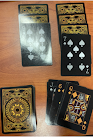
The modified version is a lot like the original Solitaire, but with added challenges and implementation of the Joker cards. The Joker acts as a new lane when played, and the player has a limited amount of times they can reshuffled the deck of cards.

The target audience of the game is single players who are achievers, because the goal is to get all the suits in their own piles, but that isn't always possible to achieve.

There were a couple problems in the design process, such as the images that were included in the rule sheet, and the wordiness of the rule sheet. Different images were added to make certain rules more clear, like the images to help explain the Joker rule.

Another image that was added was an image to help explain the discard pile rule. The player can only use a discarded card up to 4 times after it has been placed in the pile.


Some things I would change about my own development going forward is making the rule sheet more concise while still making the point that needs to be made. I also plan to not assume any rules are implied in the rule sheet. Listing out every single rule before putting each one in the rule sheet would help ensure that I don't forget a rule that needs to be included in the game.


Solitaire Rule Sheet V.1 and V.2

 Group number: 1


My group member and I created a version of Solitaire that implemented the two Jokers and a point system, and it took away a lot of the player's choices. 

The game is set up as a normal Solitaire game, and the leftover cards in the deck are placed face down next to the lanes. Before the player can use the deck, they must assess wether they are able to move any of the face up cards in the field. The player must move the cards in the field if possible before they can go through the deck. Once all moves that can be made are made, the player can go take the top card on the deck. If the card can be used, it must be used; if the card can't be used, it is then placed in the discard pile. 

If the player comes across a Joker, the player can then make a new lane and pick a face down card from the lanes to place face up onto the Joker. The Joker lane is then played as a regular lane.

If the player wants to use a card they previously discarded, they can go through the discard pile to do so at a maximum of 4 times per round. Once the player goes through the whole deck, they then shuffle the discard pile and play as before. If the player goes through the deck 3 times, the player loses. A point is rewarded any time a card is placed or moved on the field, and 5 points are rewarded for putting a card in the Ace piles. The goal is to get all the cards in ascending order by their suit or to get as many points as possible.

Some issues that occurred were figuring out a way to make players need to reach into the discard pile. The solution was giving a point system rather than simply the goal of placing all the cards in ascending order. The point system also posed an issue if the player decided to move a card between two cards continuously, so we added a rule that points are only awarded for each card once.